Our primary school caters for students with physical disabilities and/or severe health impairments from 4.8 to 12 years old and follows the Victorian Curriculum 2.0. The program provides students with opportunities to build strong foundations in learning while nurturing their wellbeing, curiosity and personal development.
Students in the early years participate in English, mathematics, digital technologies, the arts, and health and physical education. In later primary, the program expands to include science, humanities, and design technologies, supporting students to explore new subject areas while continuing to strengthen their core learning.
ENGLISH
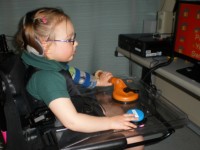
Students engage with a wide range of texts including picture books, stories, rhyming verse, poetry, non-fiction works, information texts, short films and animations. In the early years, all students take part in daily explicit phonics instruction, with continued phonics teaching in later primary school for those still developing their independent reading and writing skills. All students have access to alternate writing tools such as alphabet charts, laptops, switch adapted keyboards and eye gaze technology, ensuring every student can participate meaningfully in writing activities.
MATHEMATICS
In mathematics all students study number, algebra, measurement, space, and statistics. Lessons are taught through explicit instruction at each student’s point of need, with concepts introduced clearly and systematically. Adapted and accessible resources such as switch adapted dice and spinners, large scale and high contrast manipulatives, tactile number lines and custom 3D printed tools ensure that every student can access learning and experience success in mathematics.
TECHNOLOGIES
In Digital Technologies, students learn to use assistive technologies such as switches or eye gaze to access computers, tablets and communication systems. Accessible software, robotics and multisensory spaces are used to engage students in creative and meaningful ways. In Design and Technologies, students in the early years explore design through activities linked to their book studies. In later primary school, students engage in a broad range of design and technologies experiences including cooking, gardening and Lego club. Learning is supported by accessible facilities such as an adapted kitchen, raised garden beds, and switch accessible blenders, pourers and sewing machines.
SCIENCE
In Foundation to Year 3, science is explored through activities linked to the English topics. This integrated approach encourages younger students to connect their reading with the world around them, fostering curiosity and understanding. In the later primary years, science is studied as a separate subject. Topics include On the Move, Features of Animals and Plants, Materials, Survive and Thrive, Any Day Outdoors, and Taking Care of the Earth. All students participate in hands on investigations using adaptive science equipment, ensuring every learner can take part in all science lessons.
HUMANITIES
In the early years, humanities learning is connected to students’ book studies, helping them link stories with the wider world and building their sense of community, identity and belonging. In the later primary years, students study dedicated history and geography units. Humanities topics currently include Healthy Habitats, Journey Around Australia, Continents, Countries and Maps, The First Australians, Australia in the 1800s, and Contributions to Community. Accessible resources such as virtual reality headsets, 3D printed models, 360 degree videos and hands on historical objects support students to engage actively with the past and present.
HEALTH AND PHYSICAL EDUCATION
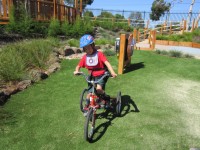
Primary students take part in at least three hours of physical education each week, supported by a physiotherapist and tailored to their individual goals. This includes fortnightly sessions in our accessible hydrotherapy pool. Many classes utilise our motor sensory space, which has been purpose built to support students’ physical development. Through physical education sessions students focus on both individual skill development and group games that promote cooperation, communication and teamwork. In health, students participate in lessons focused on respectful relationships, growing and changing, wellbeing, sun safety, bike safety, families and friendships. A strong focus on wellbeing underpins all learning, helping students to feel safe, supported and ready to learn.